Cargando tu pedido...
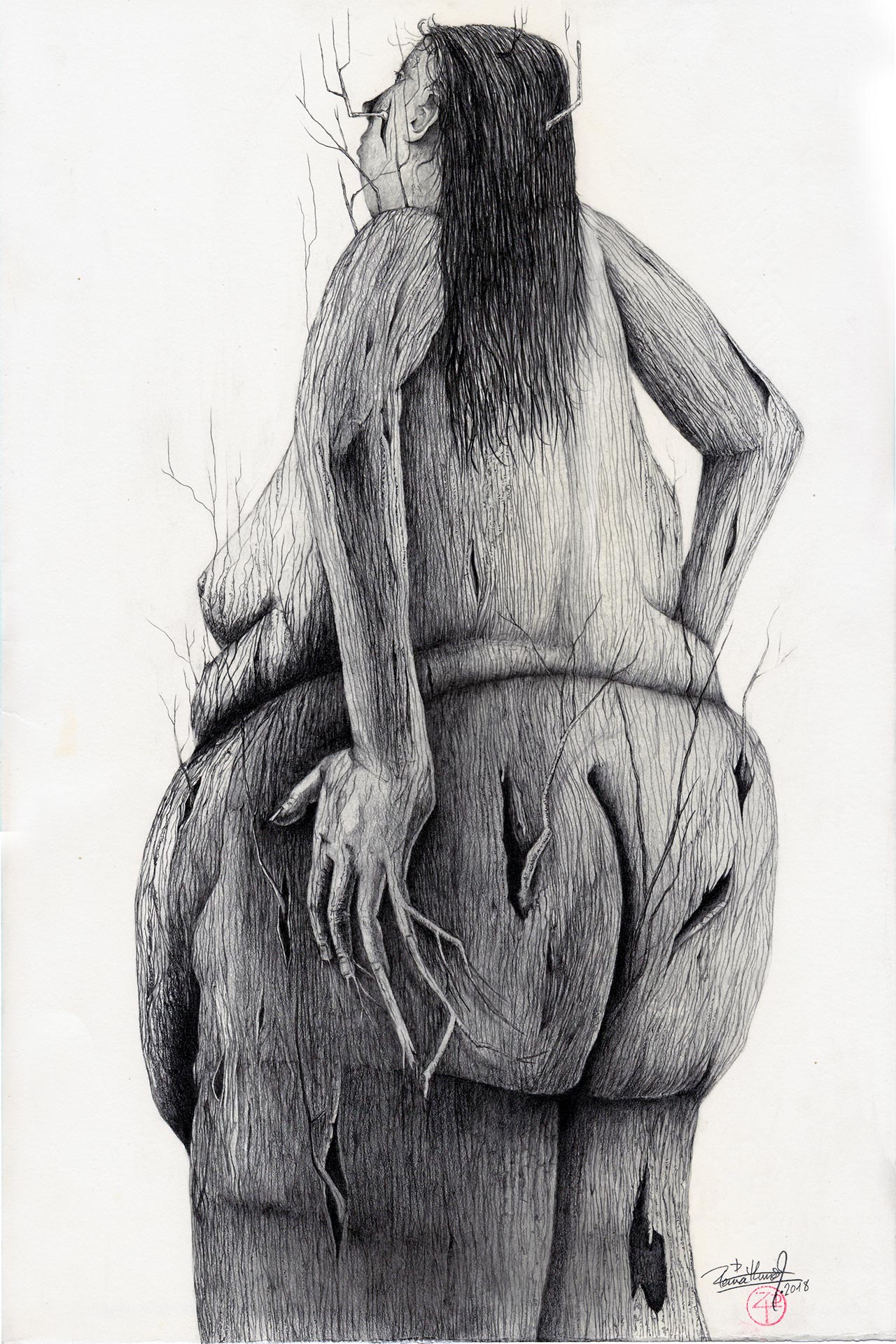
In En tenue d’Ève, the female body appears close to origin — not as narrative, but as presence.
The reference to Eve is not treated as a biblical illustration but as a symbolic threshold: the moment when the body emerges before the roles, projections, and interpretations that history has placed upon it.
The drawing does not seek to define identity. Instead, it suggests a state of suspension where the figure exists prior to classification: neither character nor myth, but a body inhabiting its own immediacy. Graphite allows the form to remain open, almost provisional, as if the body were still negotiating its emergence.
Within the context of The Shape-Shifting Woman, the work acquires a particular resonance. Placed after First Gesture, where the feminine sign is inscribed in stone, En tenue d’Ève introduces the body as incarnation. The primordial mark becomes presence; the sign takes form.
In this sense, the drawing marks a subtle passage: from the first trace to the body capable of transformation.
First presented in:
Transforming, Martin’s Atelier, Brussels — 2020
Exhibited again in:
The Shape-Shifting Woman — 2026