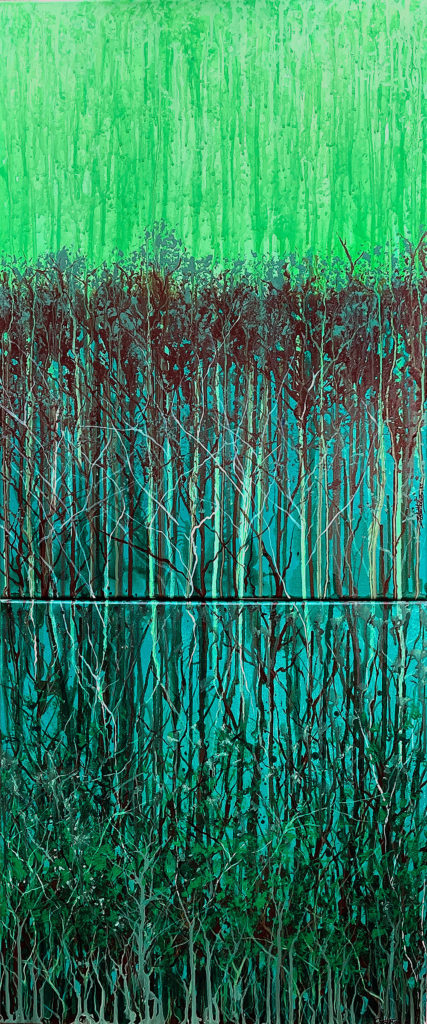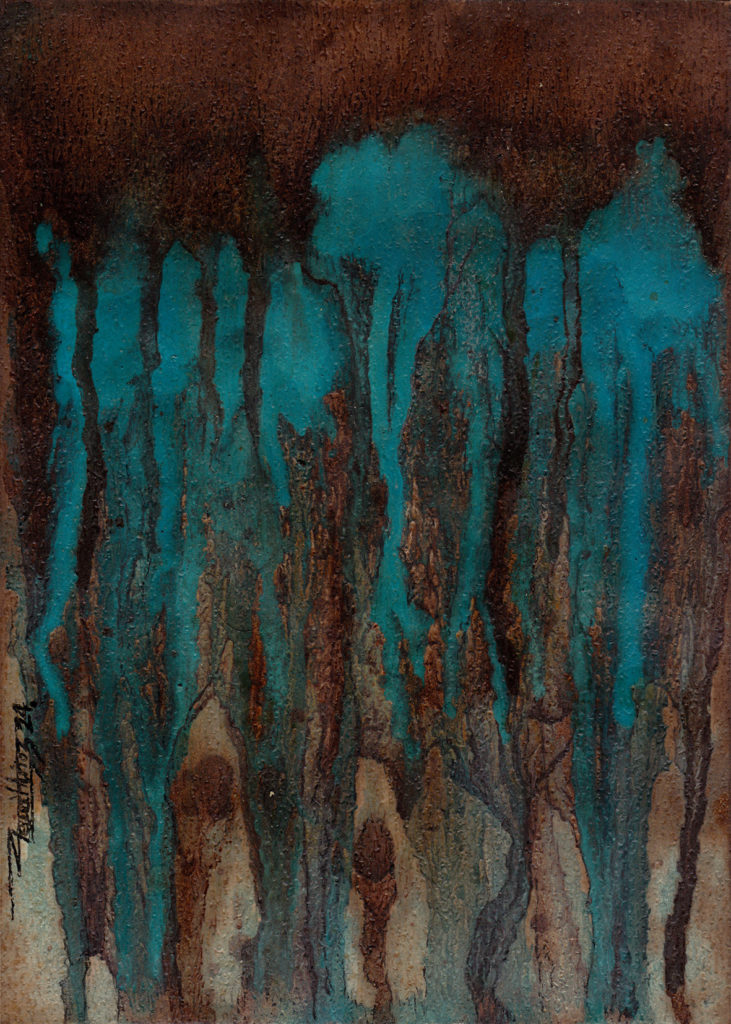
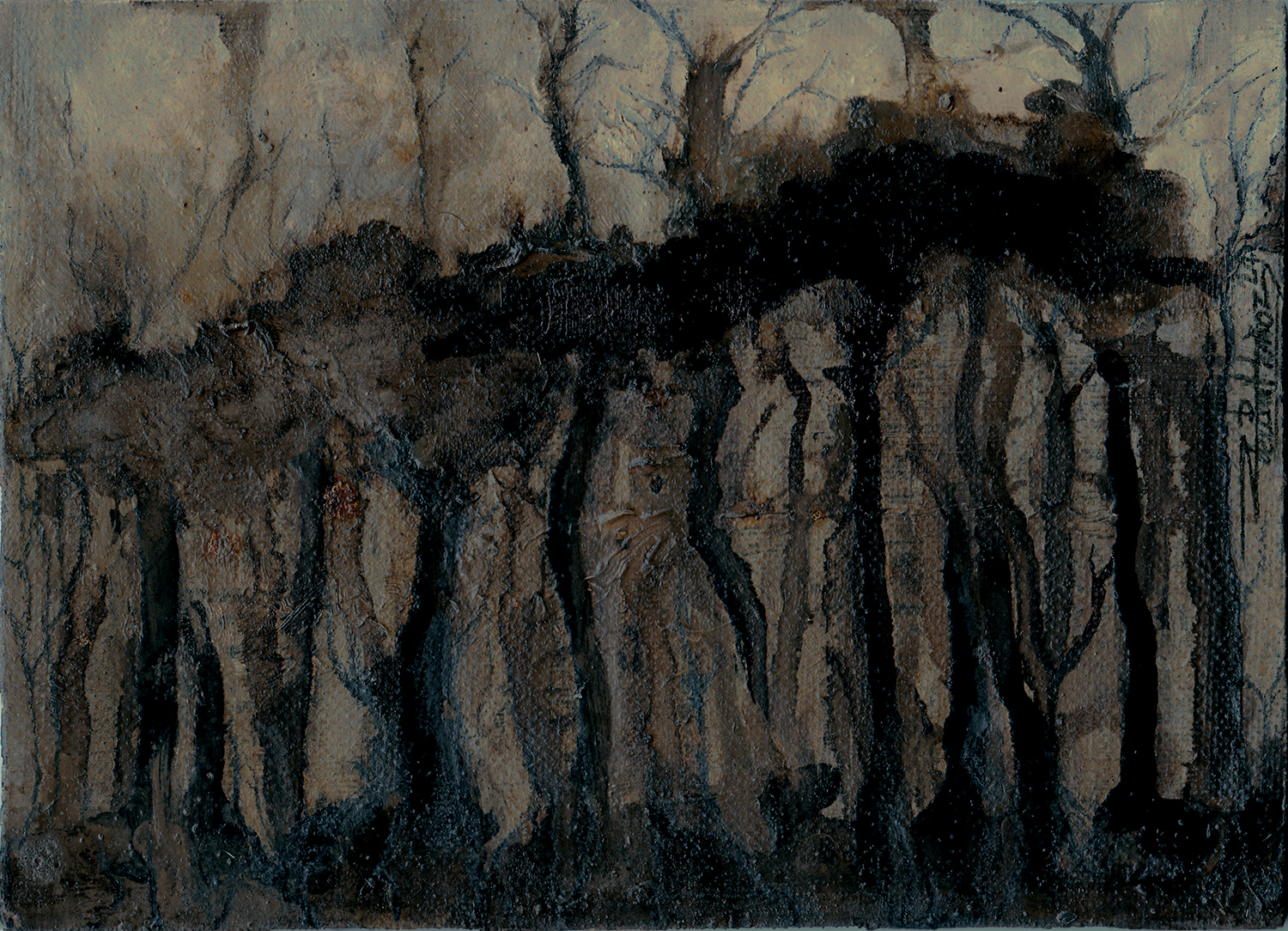
In some remote corner of a still-wet canvas stretched a dark, misty forest. It was a forest that belonged neither to the earth nor to time; its very existence was a contradiction of all natural laws. There, the mist was as dense as tightly woven silk, yet ethereal, like a half-formed thought. The roots of the trees did not grow from the ground; they spiraled toward the sky, twisting like imploring hands.
This forest was born from the restless hand of an uneasy artist, a creator trapped in the abyss between inspiration and obsession. His brushstrokes were sighs, and his colors were faded memories. Each tree was an idea he had tried to express but, for reasons unknown, had never fully realized. And now they were there, prisoners, frozen in an eternal gestation.
Walking through this tangle of impossible forms, the forest seemed to change with each step. One could feel the shadows dancing at the edges of vision, hear the trees murmuring in a language not entirely human. The mist did not merely conceal; it created. Sometimes, it condensed into shapes that seemed to want to take form, figures that briefly rose before vanishing, leaving behind the faint scent of turpentine.
A crow, painted in a black so deep it seemed to absorb the light, perched on the branch of a tree that dripped paint, as though it was still in the process of drying. The bird turned its head in an unnatural motion and fixed its shining, questioning eye on anyone daring to enter that space. It did not caw. It merely watched, its gaze a mix of warning and curiosity, as if inviting the intruder to uncover a secret that perhaps should remain hidden.
At the heart of the forest lay a clearing where the mist seemed to settle like a heavy blanket. In the center of this space stood an easel, tilted and worn, with a half-painted canvas. The image on it was confusing, as if it was being created and undone simultaneously. An invisible hand worked frantically upon it, rapid, chaotic brushstrokes never quite managing to define a form. It was the artist himself, trapped within his own creation, struggling to make sense of the chaos he had invoked.
The forest was a reflection of his mind: a place overcrowded with unfinished possibilities, ideas that had never found their final destination. Here, everything was alive, but in a perpetual state of incompleteness, as if the act of finishing meant its death. The artist seemed to understand this; every time he approached the final stroke, the forest writhed in protest, the trees groaned, and the mist thickened until vision became impossible.
Suddenly, an unreal beam of light—a flash from no sun or lamp—pierced through the mist, falling directly on the canvas. For an instant, everything froze. The trees stopped murmuring, the mist hung motionless in the air as if solid, and the crow tilted its head with an almost human interest. The invisible hand trembled, and the brush it held fell to the ground, disintegrating into a puddle of impossible colors.
The canvas, now fully illuminated, revealed the forest itself. But this time, it was neither dark nor shrouded in mist. It was complete, serene, as though the act of being finished had granted it a peace it previously lacked. The trees were firmly rooted in solid ground, the shadows were warm, and the mist had dissolved into fresh, clear air.
Yet, after a mere breath, the light vanished, and the forest returned to its original state. The shadows resumed their unsettling dance, the trees twisted back toward the sky, and the mist once again filled every corner with its suffocating embrace.
The artist, or what remained of him, was no longer at the easel. Only the forest persisted, like an open wound on the canvas of reality. Perhaps, an unlikely observer might think, the artist had become the forest itself, and this was now his testament: a work that could never be finished, because its purpose was not to be understood, but simply to exist.